Academic Publications
An Ordinal Logistic Regression Model to assess the impact of inflation on households’ ability to afford basic necessities in the Chittagong Hill Tracts
Submitted for PublicationThis study examines how inflation affects households’ability to afford basic necessities in the Chittagong Hill Tracts (CHT) of Bangladesh using survey data from 420 households and an ordinal logistic regression model. Affordability difficulty is treated as an ordered welfare outcome, allowing identification of varying levels of economic stress. Results show a strong nonlinear effect of inflation: households perceiving moderate and high price increases are about 37 and 70 percentage points more likely, respectively, to face extreme affordability difficulty. Higher income significantly reduces vulnerability, while worsening employment conditions sharply increase hardship. In contrast, education, occupation, and number of earners have limited influence once economic shocks are considered. The findings highlight inflation severity, income constraints, and labor market instability as the primary drivers of welfare loss, emphasizing the need for targeted income and employment protection alongside price stabilization policies in marginalized regions.
Keywords:
Inflation, Affordability, CHT
Energy Transition and Green Innovation: Testing the Load Capacity Curve in Climate-Vulnerable Bangladesh
Submitted for PublicationBangladesh is facing a critical moment due to serious ecological pressure from rapid economic growth, which is driving climate change and environmental degradation. This study examines the determinants of the load capacity factor (LCF) by using annual data from 1990 to 2024. We use ARDL, NARDL, and QARDL models to investigate long-run relationships, asymmetric effects, and state-dependent dynamics. The results yield three core findings for innovation-led green development: (i) renewable energy, a key determinant of ecological sustainability, improves ecological capacity by 1.77% for every 1% increase in renewable energy. (ii) fossil fuel consumption reduces the LCF asymmetrically. A 1% decrease in fossil fuel use improves ecological capacity more than twice as much as a 1% increase harms it. (iii) the relationship between income and ecological sustainability confirms an inverted U-shaped Load Capacity Curve (LCC), but only under high ecological stress (75th quantile). These findings emphasize the urgency of accelerating renewable energy deployment, lessening dependency on fossil fuels, and prioritizing green financial instruments as a central pathway toward ecological sustainability.
Keywords:
Load Capacity Factor; renewable energy; fossil fuels; green innovation; ecological sustainability; Bangladesh
Inflation and Socioeconomic Challenges in the Chittagong Hill Tracks: Implication for Sustainable Development in the Post-LDC Bangladesh
Submitted for PublicationThis study examines how inflation affects access to food, healthcare, education, employment, housing, and transportation in the Chittagong Hill Tracts (CHT), and its impact on the purchasing power and resilience. With Bangladesh now beyond LDC status, the government needs policies to address inflation and protect households. By offering recommendations for improving economic stability, reinforcing social safety nets, and tailoring region-specific strategies to address inflation, this study contributes to the ongoing discussion on sustainable development in post-LDC Bangladesh.
Keywords:
CHT, SDG, Inflation, Sustainable Development, Post-LDC Bangladesh
Energy Transition, Financial Development, and Ecological Capacity: Nonlinear Evidence from a Carbon-Negative Economy of Butan
In PreparationBhutan, one of the world’s few carbon-negative economies, faces increasing pressure to sustain ecological capacity amid economic transformation, rising fossil fuel use, and expanding financial development. This study examines the effects of income, energy transition, and financial development on Bhutan’s Load Capacity Factor (LCF) using annual data from 1990–2024. To capture long-run, asymmetric, and distributional dynamics, the study applies ARDL, NARDL, and QARDL models. The findings confirm an inverted U-shaped relationship between income and ecological capacity, supporting the Load Capacity Curve hypothesis. Financial development is found to enhance LCF, while renewable energy improves ecological sustainability more strongly than non-renewable energy. The results also reveal asymmetric and quantile-specific effects, highlighting that Bhutan’s ecological resilience depends on maintaining its renewable energy advantage and managing emerging fossil fuel pressures. Overall, the study provides important policy insights for balancing growth and environmental sustainability in a carbon-negative economy.
Keywords:
Load Capacity Factor, Load Capacity Curve, Renewable Energy, Financial Development, Ecological Sustainability, Bhutan
Non-Academic Publications
Smartphone addiction among children
Smart economy and relevant challenges
Climate change causes California wildfire
Climate change affects firms competitiveness
Conference Publications
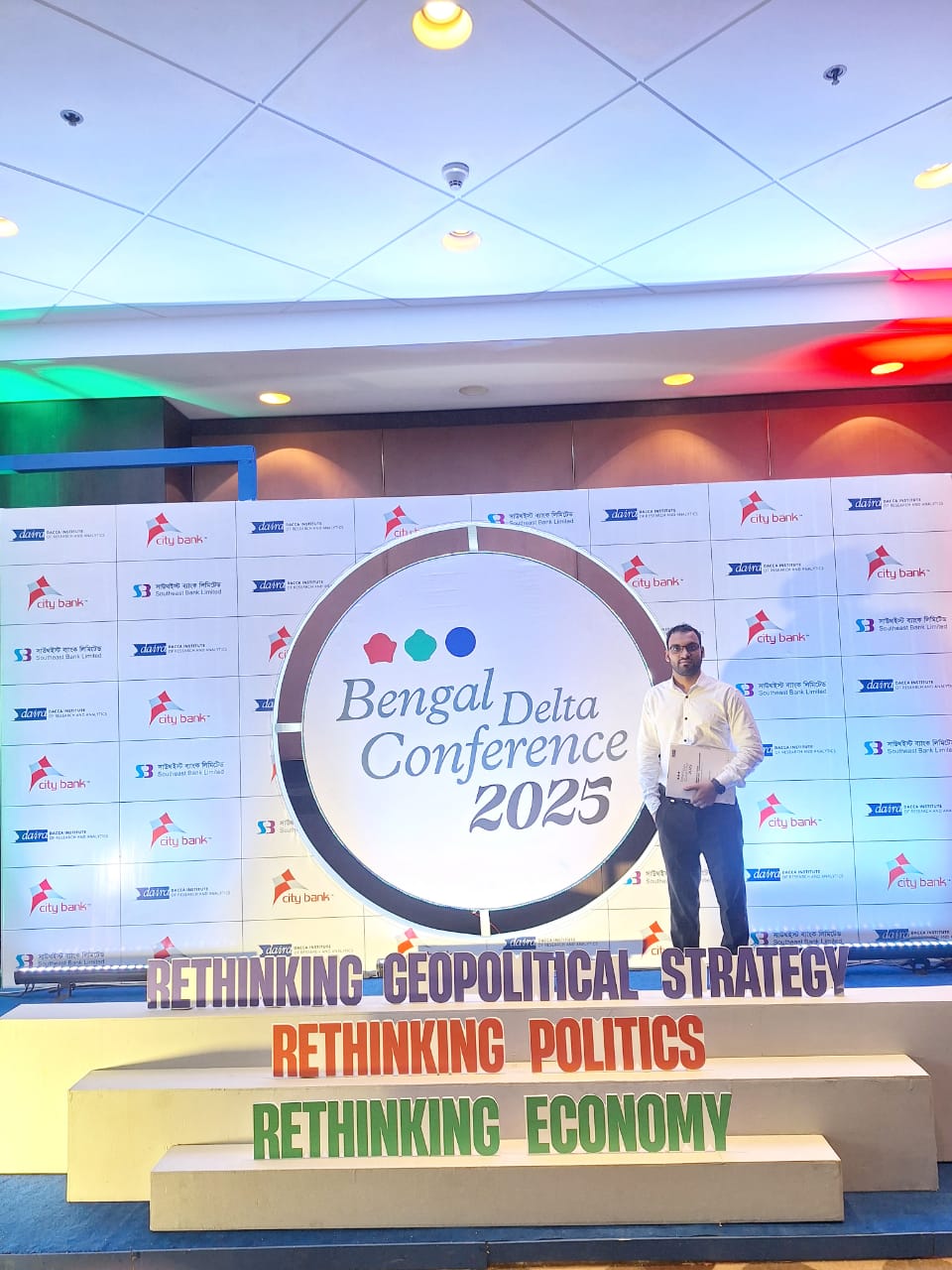
Bengal Delta Conference 2025 - Inflation and Socioeconomic Challenges in the Chittagong Hill Tracks
PublishedConference Title
Bengal Data Conference 2025
Organizer
Dacca Institute of Research and Analytics (DAIRA)
Location
Hotel InterContinental, Dhaka
Abstract
Paper presentation at the Bengal Delta Conference 2025 examining inflation and socioeconomic challenges in the Chittagong Hill Tracks and implications for sustainable development in post-LDC Bangladesh.
Keywords
Conference, CHT, Inflation, Sustainable Development
Conference Photos
Conference Videos
Work in Progress
Innovation-Mediated Drivers of Bangladesh’s Load Capacity Factor (1990–2023): Evidence from a Parsimonious Fourier-NARDL Framework
In PreparationRESEARCH PROPOSAL Title: Innovation-Mediated Drivers of Bangladesh’s Load Capacity Factor (1990–2023): Evidence from a Parsimonious Fourier-NARDL Framework ________________________________________ 1. Background and Rationale Bangladesh’s rapid economic growth, expanding energy demand, and deepening global integration have intensified environmental pressures while simultaneously creating opportunities for green transformation. Conventional environmental indicators—particularly carbon dioxide emissions—capture only partial aspects of ecological degradation and fail to incorporate regenerative ecological capacity. The Load Capacity Factor (LCF), defined as the ratio of biocapacity to ecological footprint, provides a more comprehensive sustainability metric by jointly measuring ecological pressure and resilience. Recent empirical work has begun applying LCF to Bangladesh using globalization-related drivers; however, the critical mediating role of domestic innovation systems—especially green technological creation and R&D investment—remains unexplored. This study argues that the environmental effectiveness of renewable energy expansion, foreign direct investment, and trade openness is conditional upon the strength of local green innovation capacity. Without innovation, globalization may intensify ecological stress; with innovation, it may enhance sustainability. To test this mechanism, the research applies a parsimonious nonlinear Fourier-NARDL model capable of capturing: • asymmetric responses to positive and negative shocks • structural breaks from policy reforms and global shocks • long-run and short-run sustainability dynamics This integrated design delivers clear theoretical novelty, methodological rigor, and policy relevance aligned with Q1 journal expectations. ________________________________________ 2. Research Objectives General Objective To examine how globalization and energy transition influence Bangladesh’s ecological sustainability conditional on green innovation capacity. Specific Objectives 1. Estimate long-run and short-run effects of renewable energy, FDI, trade openness, and green innovation on LCF. 2. Identify asymmetric impacts of positive versus negative shocks in core drivers. 3. Detect structural breaks in Bangladesh’s sustainability trajectory. 4. Test causal relationships among innovation, globalization, energy use, and ecological sustainability. 5. Provide policy-relevant sustainability scenarios based on innovation-mediated pathways. ________________________________________ 3. Research Questions Primary Question How do renewable energy, FDI, trade openness, and green innovation jointly shape Bangladesh’s ecological sustainability measured by LCF under nonlinear and structural-break dynamics? Supporting Questions • Does green innovation moderate the environmental effects of FDI and trade? • Are sustainability responses asymmetric to positive and negative shocks? • Do structural policy periods alter long-run ecological relationships? • Which policy lever yields the greatest sustainability improvement? ________________________________________ 4. Hypotheses H1: Renewable energy consumption increases LCF in the long run. H2: FDI inflows exhibit asymmetric environmental effects—positive shocks reduce LCF (pollution-haven mechanism), while negative shocks do not symmetrically improve it. H3: Trade openness has nonlinear sustainability effects that depend on the level of green innovation. H4: Green innovation significantly enhances long-run ecological resilience and offsets negative globalization effects. H5: Structural breaks linked to major policy transitions significantly change the long-run innovation–LCF relationship. ________________________________________ 5. Conceptual Framework Dependent Variable • Load Capacity Factor (LCF) Robustness DV • Inverted LCF Core Independent Variables (Parsimonious Model) • Renewable energy consumption • Foreign direct investment (% GDP) • Trade openness (% GDP) • Green innovation (environmental patents) Essential Control Variables • GDP per capita • Total energy use Extended Robustness Variables • R&D expenditure (% GDP) • Economic complexity • Urbanization (alternative demographic control) 6. Data Description Coverage • Annual data: 1990–2023 (maximum availability) Primary Sources • Global Footprint Network — LCF • World Bank WDI — GDP, energy, trade, FDI, population, R&D • IEA / BP — renewable energy and total energy use • WIPO / OECD — environmental patents • MIT Atlas — economic complexity • Bangladesh national statistics — validation and robustness 7. Variable Construction • Log transformation for level variables to obtain elasticities. • Percentage indicators retained in natural form. • Inverted-LCF constructed as reciprocal/normalized sustainability inefficiency index. • Positive and negative partial sums generated for nonlinear NARDL estimation. 8. Empirical Methodology Step 1 — Exploratory analysis and visualization. Step 2 — Structural break detection • Bai-Perron multiple break test • Fourier approximation for smooth structural shifts Step 3 — Stationarity testing with breaks • Fourier ADF • Zivot-Andrews Step 4 — Cointegration and nonlinear dynamics • Parsimonious Fourier-NARDL estimation • Long-run, short-run, and asymmetric elasticities Step 5 — Directional causality • Toda-Yamamoto or frequency-domain causality tests Step 6 — Conditional causal robustness • Synthetic control or intervention analysis only if a sharp policy shock is empirically identifiable 9. Robustness Strategy • Alternative dependent variables (CO₂ emissions, ecological footprint). • Alternative estimators (ARDL, FMOLS, DOLS, VECM). • Innovation proxy substitution (R&D replacing patents). • Secondary model including economic complexity. • Subsample estimation around structural breaks. • Bootstrap inference and endogeneity correction where required. 10. Expected Contributions This study advances the sustainability literature by: 1. Providing the first innovation-mediated LCF analysis for Bangladesh. 2. Demonstrating that globalization’s environmental impact is conditional on domestic green innovation capacity. 3. Applying a parsimonious Fourier-NARDL framework suited to small-sample macro time series. 4. Delivering policy-relevant sustainability scenarios for renewable energy, green FDI, and innovation investment. These contributions collectively establish clear Q1-level novelty. 11. Policy Implications Findings will inform: • Renewable energy transition strategy • Regulation and targeting of environmentally sustainable FDI • Innovation-driven green industrial policy • Trade policy alignment with ecological resilience • Long-term SDG-consistent sustainability planning 12. Proposed Paper Structure 13. Introduction 14. Literature Review and Innovation-Based Research Gap 15. Data and Variable Construction 16. Methodology (Parsimonious Fourier-NARDL) 17. Empirical Results 18. Robustness and Extensions 19. Policy Discussion 20. Conclusion 13. Target Q1 Journals (Priority Order) 14. Energy Economics 15. Energy Policy 16. Journal of Cleaner Production 17. Ecological Economics 18. Journal of Environmental Management / Sustainable Production and Consumption 14. Concluding Statement This revised proposal delivers a methodologically rigorous, theoretically novel, and policy-relevant framework for analyzing Bangladesh’s ecological sustainability through innovation-mediated globalization dynamics. By combining a parsimonious nonlinear Fourier-NARDL approach with a holistic sustainability indicator (LCF), the study provides a credible pathway toward Q1 journal publication.
Keywords:
Monetary Policy Effectiveness, Exchange Rate Pass-Through, and Inflation Dynamics under Global Oil Price and Geopolitical Risk Shocks in Bangladesh
In PreparationThis study examines how global oil price shocks and geopolitical risk influence inflation dynamics in Bangladesh, with particular attention to the roles of monetary policy effectiveness and exchange rate pass-through. The project investigates whether changes in oil prices directly affect domestic inflation and whether these effects become stronger under heightened geopolitical uncertainty. It also evaluates how Bangladesh’s monetary policy responds to external shocks and whether exchange rate movements amplify inflationary pressures. Using macroeconomic time-series data, the study aims to provide policy-relevant evidence on inflation transmission mechanisms in a small open economy like Bangladesh.
Keywords:
The Impact of Ethnicity on Earning Gaps in Bangladesh: Evidence from the Chittagong Hill Tracts
Work in ProgressResearch examining the relationship between ethnicity and income inequality in the Chittagong Hill Tracts region. Data collection and analysis are currently in progress.
Keywords: